
Enterprise Resource Planning (ERP) systems sit at the center of modern business operations. They manage finance, procurement, inventory, manufacturing, customer data, and reporting. Because ERP platforms are so critical, choosing the right ERP hosting environment is a business risk, compliance, and performance decision, beyond the strictly IT considerations.
While public cloud platforms offer flexibility and scalability, private infrastructure with dedicated resources may be the better choice for organizations with strict compliance requirements, demanding workloads, or complex integration needs. Mission-critical applications such as ERP systems often require specialized infrastructure, performance isolation, and European compliance controls that generic hosting environments may not always provide.
This guide provides a practical decision flow to help organizations determine which deployment model best fits their ERP strategy.
Private Infrastructure vs Public Cloud ERP at a Glance
Private infrastructure ERP hosting is ideal for businesses with strict compliance requirements, performance-sensitive workloads, and complex integrations. Public cloud ERP hosting is often better suited for organizations prioritizing scalability, deployment speed, and operational flexibility. The public vs private cloud decision chain follows several steps.
Compliance Requirements: The First ERP Hosting Question
The first question is often the most important: Does your organization operate under strict regulatory or data sovereignty requirements?
GDPR, NIS2, and Data Sovereignty Considerations Affecting the ERP Hosting Choice
Many organizations must comply with frameworks such as GDPR, NIS2, industry-specific regulations, or contractual customer obligations. For these businesses, understanding where data resides and who can access it is critical.
Armored Cloud notes that European businesses increasingly face challenges around GDPR, NIS2, data sovereignty, and legal accountability. Hosting ERP data within secure European infrastructure can help organizations maintain greater control over compliance obligations.
Decision Point
If compliance and data residency requirements are strict:
- Consider private infrastructure or dedicated cloud resources.
- Prioritize providers that offer European-hosted environments and compliance-focused architectures.
If compliance requirements are moderate:
- Public cloud solutions may remain viable, provided appropriate security and governance controls are implemented.
Performance Isolation: Can Your ERP Handle Shared Resources?
The second question focuses on application performance: Can your ERP tolerate resource contention from other workloads?
Understanding Noisy Neighbor Risks
Many public cloud environments operate on shared infrastructure models. Although highly capable, they can occasionally be affected by “noisy neighbor” scenarios where resource consumption by other tenants impacts performance.
ERP systems are different from many standard business applications. Financial transactions, inventory processing, reporting jobs, and database-intensive workloads often have predictable but demanding performance requirements.
How Dedicated Infrastructure Improves ERP Performance
Dedicated application hosting eliminates competition for computing resources by allocating infrastructure specifically for application needs. CPU-intensive workloads receive appropriate processing power, memory-heavy applications have sufficient RAM allocation, and databases benefit from optimized storage configurations.
Decision Point
If ERP performance is business-critical:
- Choose dedicated infrastructure.
- Ensure storage, CPU, and memory resources are specifically sized to ERP workload requirements.
If occasional performance fluctuations are acceptable:
- Public cloud shared resources may provide a cost-effective option.
Integration Requirements: How Connected Is Your ERP Ecosystem?
ERP rarely operates in isolation. System connectivity needs and readiness vary widely.
Common ERP Integration Scenarios
Today’s organizations connect ERP platforms with:
- CRM solutions
- Banking systems
- Manufacturing systems
- Supply chain platforms
- E-commerce tools
- Industry-specific applications
- Custom databases
Armored Cloud highlights that complex application environments require secure network connectivity, API support, and infrastructure controls that enable multiple systems to work together reliably.
Decision Point
If your ERP connects with numerous critical systems:
- Dedicated environments can offer greater control over network architecture, security policies, and integration management.
If integrations are relatively simple:
- Public cloud deployments may be easier to deploy and manage.
Choosing ERP Hosting: Decision Flow Chart
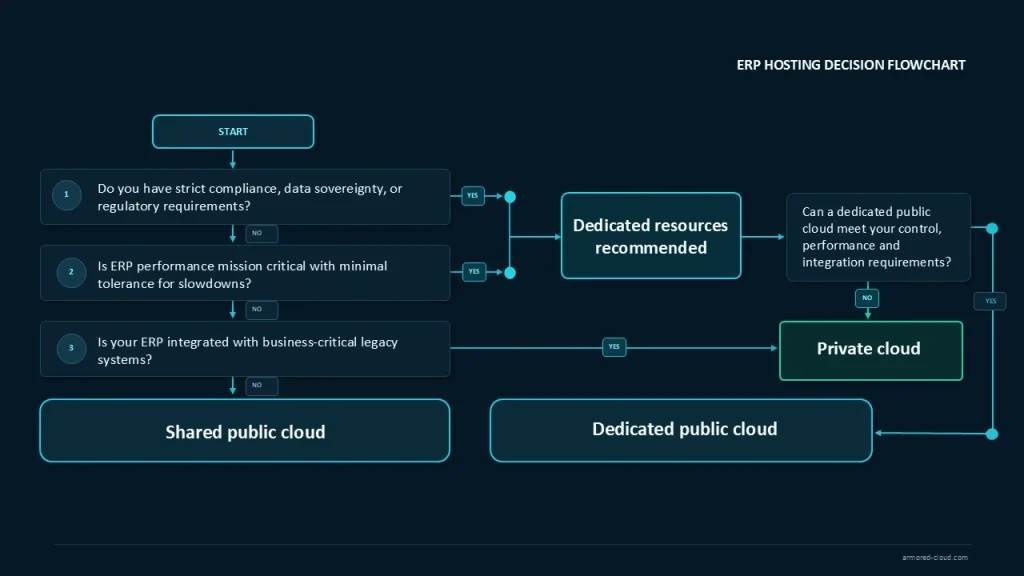
What Dedicated Resources for ERP Hosting Look Like in Practice
Many decision makers hear the phrase dedicated resources but are unsure what it means in practice. A dedicated ERP hosting environment commonly includes:
Dedicated Computing Resources
ERP workloads receive processor resources allocated specifically to the organization rather than shared across multiple tenants. This provides predictable system responsiveness and transaction processing.
Dedicated Memory Allocation
Memory-intensive ERP functions such as financial reporting, planning calculations, and inventory analysis have reserved RAM capacity available when needed.
High-Performance Storage for ERP Databases
Databases benefit from storage optimized for high transaction volumes and low latency, helping improve application responsiveness and reporting performance.
Security and Compliance Controls
Dedicated environments provide stronger separation between applications and workloads. Armored Cloud describes implementing firewalls, intrusion detection, vulnerability monitoring, role-based controls, and audit logging to enhance security and governance.
Dedicated environments can be designed around specific regulatory requirements, including European jurisdiction hosting and controls aligned with GDPR and NIS2 expectations.
When Public Cloud ERP Hosting Is the Right Choice
Public cloud remains a strong option for many organizations. It is particularly attractive when:
- Compliance requirements are limited.
- Workloads are variable and unpredictable.
- Rapid deployment is a top priority.
- Cost optimization outweighs performance predictability.
- ERP is not the sole business-critical application.
Organizations can benefit from fast scalability and broad service availability while avoiding large infrastructure commitments.
However, public cloud may require additional planning when regulatory requirements, performance guarantees, or security segmentation become more demanding.
Private Cloud vs Public Cloud ERP: Side-by-Side Comparison
The right ERP hosting decision depends on three primary factors: compliance, performance isolation, and integration complexity.
| Evaluation Criteria | Private Cloud ERP | Public Cloud ERP |
| Infrastructure Model | Dedicated or isolated resources allocated to a single organization. | Shared infrastructure serving multiple customers. |
| Compliance & Data Sovereignty | Strong control over data residency, governance, and regulatory compliance. Ideal for GDPR, NIS2, and industry-specific requirements. | Compliance capabilities are available, but organizations may have less control over data location and infrastructure policies. |
| Performance Predictability | Consistent performance with dedicated CPU, memory, and storage resources. | Performance is generally strong but may be affected by resource sharing and multi-tenant architectures. |
| Resource Isolation | Complete workload separation minimizes “noisy neighbor” risks. | Resources are typically shared across multiple tenants. |
| Security Control | Greater control over security policies, network segmentation, access management, and monitoring. | Security is managed through provider controls and shared responsibility models. |
| Integration Flexibility | Supports complex ERP ecosystems with custom networking, APIs, and legacy system integrations. | Can support integrations but may have limitations depending on cloud architecture and service models. |
| Customization | High degree of infrastructure and application customization. | Customization options may be constrained by the provider’s platform standards. |
| Scalability | Scalable, but expansion may require infrastructure planning and resource allocation. | Highly elastic with rapid on-demand scaling capabilities. |
| Implementation Speed | Typically requires more planning and configuration. | Faster deployment and provisioning. |
| Operational Management | Can be managed internally or through a hosting provider with dedicated support. | Infrastructure management is largely handled by the cloud provider. |
| Cost Structure | Higher initial investment but predictable resource allocation and performance. | Lower upfront costs with consumption-based pricing models. |
| Business Continuity | Tailored backup, disaster recovery, and availability strategies. | Built-in resiliency options, though recovery objectives may depend on service tiers. |
| Best Fit For | Organizations with strict compliance requirements, mission-critical ERP workloads, sensitive data, or complex integrations. | Organizations prioritizing agility, rapid deployment, and flexible scaling with moderate compliance requirements. |
Final ERP Hosting Recommendation
If your organization manages sensitive regulated data, depends on consistent ERP performance, or runs a highly interconnected business environment, dedicated infrastructure deserves serious consideration. As outlined by Armored Cloud’s Secure Application Hosting solution, dedicated resources provide performance optimization, enhanced security controls, integration flexibility, and European compliance support specifically designed for mission-critical applications such as ERP systems.
For organizations with lighter requirements and greater flexibility, public cloud remains a practical and cost-efficient option. The key is to evaluate business needs objectively rather than assuming one deployment model fits every ERP workload.
In ERP hosting, the best decision is not the newest trend. It is the environment that aligns most closely with your operational, regulatory, and performance requirements.
Frequently Asked Questions
Is private cloud better than public cloud for ERP?
Private cloud ERP hosting is often the better choice for organizations that require strict compliance, predictable performance, dedicated resources, and greater control over sensitive business data.
What are dedicated resources in ERP hosting?
Dedicated resources refer to computing power, memory, storage, and network capacity allocated exclusively to your ERP environment rather than shared among multiple customers.
Why is data sovereignty important for ERP systems?
Data sovereignty determines where company data is stored and governed. Organizations operating under GDPR, NIS2, or sector-specific regulations often require infrastructure located within specific legal jurisdictions.
What performance benefits does dedicated ERP hosting provide?
Dedicated ERP hosting can reduce performance bottlenecks, eliminate noisy-neighbor issues, improve database responsiveness, and support consistent transaction processing.
Which businesses should consider private ERP infrastructure?
Organizations in finance, healthcare, manufacturing, logistics, legal services, government contracting, and critical infrastructure sectors frequently benefit from private cloud or dedicated ERP environments.