
A strategic guide for executives navigating the intersection of AI adoption, data sovereignty, and European regulations. Part 1 covers the business case, industry use cases, and the competitive calculus of sovereign vs. public AI infrastructure.

Every European executive faces a key question in 2026: how do we capture the value of AI? and how do we actually use AI without creating legal, competitive, or financial problems we didn’t see coming.
The easy answer is to plug into OpenAI, Anthropic, or Google’s API and move fast. That works fine until it does not. And for a growing number of European businesses, it has already stopped working. Enterprise procurement teams are asking where data goes. Regulators are enforcing where data stays. Competitors who can answer both questions are better positioned for winning deals.
This article offers a strategic outlook built on direct experience running Fintech, Medtech and other AI-powered companies with both using frontier models and local deployments. Compliance matters, no doubt. But the real question is how a European business captures the full value of AI while turning data residency and regulation into an advantage over competitors.
The strategic landscape: AI adoption is accelerating
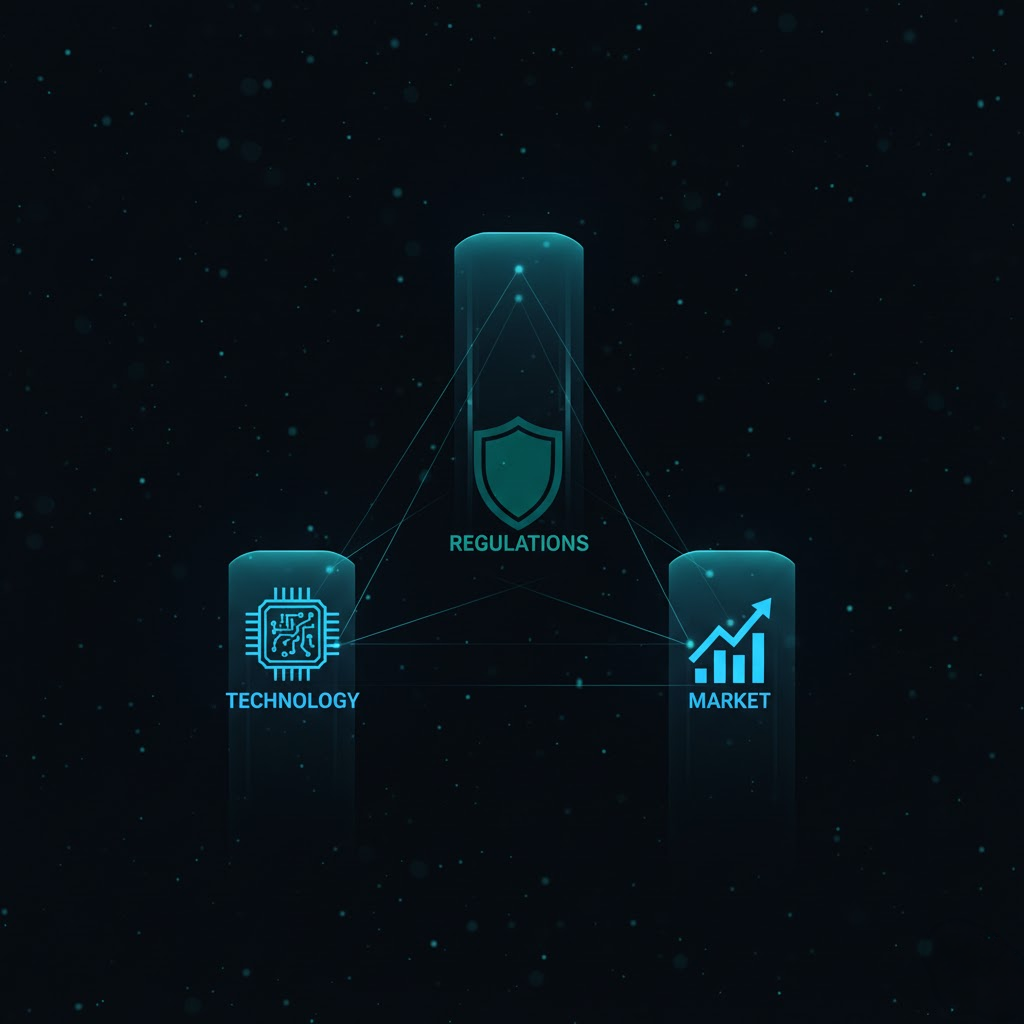
Three things changed at once and together they made sovereign AI infrastructure a pressing business priority rather than a niche concern.
The regulatory walls went up. NIS2 brings thousands of European SMBs under its scope for the first time. The EU AI Act requires full auditability for high-risk AI systems from August 2, 2026. Schrems II has made cross-border data transfers to US infrastructure legally precarious. These are not future risks but current obligations with enforcement timelines already underway. And it goes beyond regulation. Geopolitical shifts and unpredictable tariff changes have made relying on US infrastructure feel riskier, too.
The technology caught up. Open-source AI models – Llama, Mistral, and others – now deliver production-grade performance for the majority of business applications, including document analysis, customer support, code assistance, classification, and domain-specific tasks. The capability gap between these models and proprietary frontier APIs has narrowed significantly. For many business use cases, it is no longer a real limitation.
The market signalled demand. The European sovereign cloud market reached $69.4 billion in 2026, growing 83% year-over-year. Search demand for “European cloud alternatives” grew 660%* in 2025. Forty-eight percent of technology buyers expect their sovereign cloud AI usage to increase over the next two years. Mistral committed EUR 1 billion in capital expenditure for sovereign compute in 2026. The market has moved beyond a short-term trend.
For executives, the strategic question is no longer whether sovereign AI matters. It is how fast to move and where to position.
The business case: sovereign AI beyond regulatory compliance
Conventional thinking positions sovereign infrastructure as a compliance cost, something you do to avoid fines. That is a misguided interpretation, and for many businesses it is quite the opposite. Competitive advantage through AI, revenue and predictable costs should be the starting point for any practical analysis.
Sovereign AI as revenue enabler
For B2B companies and especially for European tech startups selling to enterprise customers, sovereign infrastructure directly accelerates revenue.
Enterprise procurement in regulated industries now routinely asks, Where does my data go when your product processes it? If the answer is “to a US-based API,” the deal takes longer, stalls or dies. If the answer is dedicated European infrastructure with full audit trails and a verifiable trust page, you win the deal.
The advantages are evident and measurable. Companies that can demonstrate sovereignty through real-time compliance dashboards, verifiable data residency, and documented audit trails are winning contracts in healthcare, financial services, government, legal that competitors relying on public APIs cannot enter.
The ROI calculation is not “infrastructure cost versus API cost”. It is infrastructure cost versus API cost – plus the deals you win, the markets you can enter, the compliance workload you spare, and the trust you build over time.
Predictable economics and scalability
Public AI APIs charge per token and costs scale linearly with usage. There is no volume discount: every additional inference call costs the same.
Sovereign infrastructure inverts this. The upfront investment is higher, but per-query costs decline as usage grows. For a 50-person company making thousands of daily AI requests, breakeven against API pricing typically comes within 6-12 months. Beyond that, sovereign infrastructure is significantly cheaper per query and at the same time eliminates compliance overhead that typically runs EUR 20,000-50,000 annually in manual audit work.
For anyone planning 12-24 month budgets, sovereign infrastructure offers cost predictability that per-token pricing simply cannot match. Costs no longer accumulate through token usage, which can be difficult to predict and control.
Intellectual property protection
Every prompt sent to a public AI API containing customer data, proprietary algorithms, financial models, product designs, or strategic documents is processed on third-party infrastructure in a multi-tenant environment. The provider determines logging, retention, and caching policies, and those policies can change quickly and unilaterally. The discussions about DoD negotiations with Anthropic and OpenAI illustrated this risk clearly.
For companies where competitive advantage depends on proprietary data and domain expertise, the risk is not negligible and has nothing to do with regulations. The question is whether your most valuable intellectual property should be processed on infrastructure out of your control, alongside other companies’ data, in a jurisdiction subject to foreign government access requests.
Industry Use Cases: Where Sovereign AI Is Required
Healthcare and life sciences
Patient records, clinical notes, diagnostic imaging, and genomic data fall under GDPR Article 9 the highest level of data protection. The EU AI Act classifies healthcare AI as high-risk, requiring full technical documentation, model cards, audit trails, and risk assessments before deployment.
The executive reality: A healthtech company using a US-hosted AI API for diagnostic support or patient history is making a cross-border data transfer with every inference call, processing data on infrastructure it cannot audit, and building a compliance gap it will be held accountable for starting August 2026. Sovereign infrastructure resolves that challenge.
The business impact: Healthcare AI on sovereign infrastructure opens doors to hospital networks, national health systems, and clinical research institutions that will not work with vendors who cannot demonstrate data residency and auditability of AI-assisted decisions.
Financial services
Banks, insurance companies, fintechs, and investment firms operate under PCI-DSS, MiFID II, DORA, and national banking regulations. DORA, enforceable since January 2025, specifically requires formal assessment and management of third-party ICT service provider risk.
The executive reality: Plugging in a public AI API for fraud detection, credit scoring, or financial analysis means allowing a third-party dependency that must be formally assessed, contractually governed, continuously monitored, and documented for regulators. For many financial SMBs, the compliance overhead of managing this third-party relationship costs more than running AI on sovereign infrastructure outright.
The business impact: Financial institutions that can demonstrate sovereign AI processing gain preferred vendor status with partner banks, insurers, and regulators who are tightening third-party risk requirements.
Legal services
Attorney-client privilege, the foundation of legal practice, creates a real problem here. Sending privileged documents to a third-party AI service for contract analysis or legal research creates a credible argument that privilege has been waived by voluntary disclosure. On the other hand, the legal practices can benefit greatly from implementation of AI in their practice, due to its ability to dig up relevant information into large volume documents.
The executive reality: Law firms and legal departments handling M&A materials, litigation documents, and regulatory filings face both privilege risk and commercial confidentiality obligations. Sovereign infrastructure keeps this data under the firm’s direct control.
The business impact: Law firms that deploy AI on sovereign infrastructure can offer AI-enhanced services to clients in regulated industries – a growing and high-margin practice area while firms dependent on public APIs cannot.
AI-Native technology startups
This is the use case executives overlook most frequently. European startups building AI-powered products face a dual pressure: they need capable infrastructure for their products, and they must demonstrate compliance to the enterprise customers who drive their revenue. Inability to comply is often a no-go from investment funds, enterprise customers or first-time customers in the regulated industries.
The executive reality: A startup sending customer data to a US API for processing is creating a data sovereignty leak that enterprise compliance teams will flag. Reliance on US-based AI tools creates a potential compliance gap that affects enterprise sales.
The business impact: Startups on sovereign infrastructure can pursue enterprise healthcare, financial services, government, and legal contracts the highest-value segments of the European market. Those on public APIs are limited to customers who do not ask questions about data residency. That segment is shrinking.
Manufacturing industry
Quality control, predictive maintenance, supply chain optimisation, and process automation in manufacturing environments – particularly in Italy, Spain, and Germany – increasingly run on AI that processes sensitive operational data, trade secrets, and supplier information.
The executive reality: Manufacturing SMBs generating AI-driven insights from production data, quality metrics, and supply chain intelligence need that data to remain under their control. Edge deployment requirements for factory floor environments add an additional layer where sovereignty matters.
The Honest Trade-Offs
Sovereign infrastructure is not universally superior. Executives should understand where it excels and where public APIs remain the better choice.
Where sovereign AI wins
| Factor | Sovereign Advantage |
| Regulated data | Eliminates cross-border transfer risk by design. No Transfer Impact Assessments required. |
| Audit readiness | Complete documentation chain: model versions, training lineage, inference logs generated automatically. |
| Cost at scale | Per-query costs decrease with volume. Predictable budgeting vs. linear API cost growth. |
| IP protection | Proprietary data never leaves your infrastructure. No multi-tenant exposure risk. |
| Enterprise sales | Verifiable compliance posture accelerates procurement. Opens regulated market segments. |
| Vendor independence | Run any open-source model. No lock-in to a single provider’s pricing or API decisions. Often free or low price for the model. |
Where public APIs win
| Factor | Public API Advantage |
| Frontier capabilities | For tasks requiring the absolute best general reasoning, proprietary models still lead. Gap is narrowing. |
| Zero infrastructure | No hardware, no ops team, no capacity planning. Pure consumption model. |
| Early experimentation | Before product-market fit, before regulated data enters the pipeline, APIs offer faster iteration. |
| Low-volume workloads | Below ~500 daily inference calls, API are typically economically favourable. |
| Non-sensitive data | Marketing, public information optimisation, internal brainstorming — no residency concern. |
Will sovereign AI deliver as promised?
The most common concern: “Are open-source models good enough?”
For 80% of business AI use cases document analysis, optimisation, classification, customer support, code assistance, and domain-specific tasks current open-source models (70B parameter class and above) deliver production-grade performance. Many can be fine-tuned on proprietary data to outperform generic frontier models in specific domains.
The remaining 20% complex multi-step reasoning across diverse domains, advanced creative tasks, and cutting-edge research applications is where frontier proprietary models maintain an edge. This gap narrows with each major open-source release.
The answer for most businesses is not “all sovereign” or “all public API.” It is a practical split of data workloads, sovereign infrastructure for anything involving regulated, confidential, or proprietary data; public APIs for non-sensitive tasks where frontier capabilities add value.
The Competitive Window
The market dynamics creates urgency. Search demand for European sovereign cloud alternatives has grown 660% year-over-year. Sixty percent of European organisations plan to increase sovereign AI investment in the next two years. Hyperscalers are responding; AWS launched its European Sovereign Cloud, Azure offers sovereign landing zones but these are priced at enterprise levels (EUR 500,000+ annual minimums) that exclude the SMB segment.
This means the opportunity window for European businesses is open right now. Companies that establish sovereign AI infrastructure today building audit trails, accumulating compliance evidence, training models on proprietary data, and earning trust credentials with enterprise customers build advantages that late movers will struggle to replicate later.
The window is roughly 18-24 months. After that, the market matures, well-funded competitors will offer similar bundles, and the first-mover’s advantage fades. The businesses that move now build valuable customer relationships, operational expertise, and verifiable compliance track records. Those that wait compete on features alone in a market where features are increasingly easy to copy.
The Decision Framework for Executives
Before diving into compliance detail (Part 2) or implementation planning (Part 3), the strategic decision is straightforward:
- Does your business process regulated, confidential, or proprietary data through AI? If yes, sovereign infrastructure is a strategic necessity.
- Does your business sell to enterprise customers in regulated industries? If yes, sovereign infrastructure is a revenue enabler.
- Is your AI usage volume growing? If so, sovereign infrastructure will cost less than APIs within 6-12 months.
- Is your competitive advantage built on proprietary data or domain expertise? If yes, that data should not be processed on third-party infrastructure.
If you answered yes to two or more, the question is not whether to invest, it is how fast and with whom.
In Part 2, we go deeper on the regulatory specifics: what Schrems II, NIS2, and the EU AI Act actually require, what happens when you fall short, and how to assess your current compliance exposure.
About Armored Cloud
We provide contractually guaranteed private cloud infrastructure with sovereign AI capabilities for European businesses from dedicated environments, legally binding disaster recovery SLAs, private AI model hosting, and automated compliance dashboards. Infrastructure that turns European regulation from a burden into a competitive advantage.
Learn more at armored-cloud.com