

Your cloud provider promises disaster recovery in 8-72 hours. But when disaster strikes, will they actually deliver?
Recent outages across major cloud platforms have exposed a troubling reality: 63% of European SMBs have disaster recovery plans on paper, but only 12% have tested them in the last year. The difference between a promise and actual performance can cost your business everything.
This isn’t about technical perfection: it’s about understanding what these timeframes actually mean, when providers can realistically deliver, and how to protect your business when they can’t.
What Do These Recovery Times Actually Mean?
Before evaluating any provider’s guarantee, you need to understand two critical metrics that determine what “guaranteed recovery” actually means.
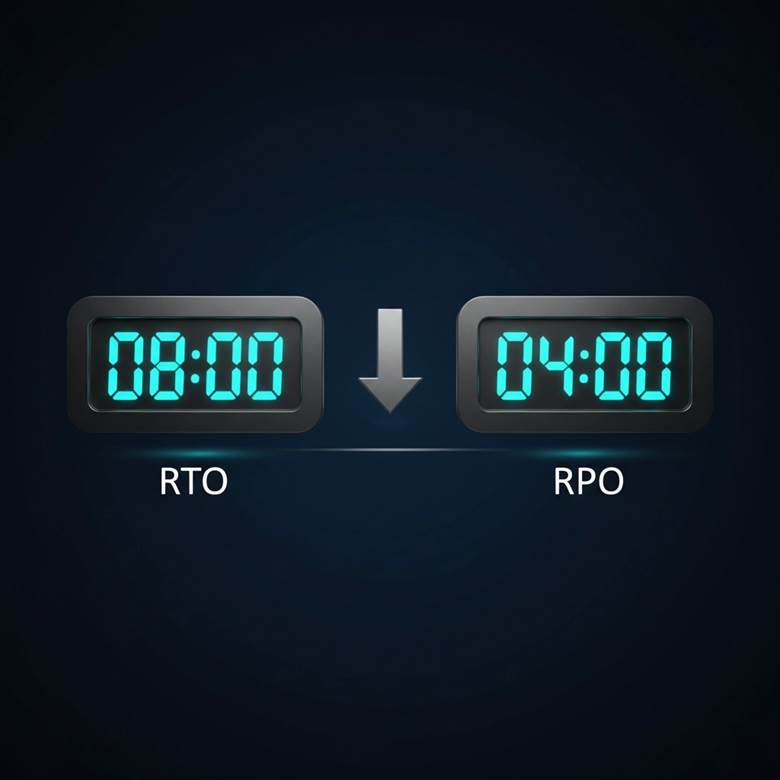
Recovery Time Objective (RTO) defines the maximum acceptable downtime your systems can experience. If your RTO is 8 hours, your business must be operational within 8 hours of a disaster.
Recovery Point Objective (RPO) specifies the maximum tolerable data loss. An RPO of 4 hours means you could lose up to 4 hours of work if disaster strikes.
These aren’t standard numbers: they vary dramatically based on your business impact analysis. A manufacturing company might survive 24-hour downtime, whilst a financial services firm might need recovery within minutes.
Here’s the crucial point: baseline RTOs commonly range around 8 hours, with baseline RPOs at 4 hours. However, organisations with critical workloads increasingly demand recovery measured in minutes, not hours.
The Reality Behind Provider Guarantees
Cloud providers outline their commitments through Service Level Agreements (SLAs) that specify performance levels for RTO and RPO metrics. But these guarantees come with significant caveats that most businesses don’t fully understand.
Your provider’s SLA performance depends entirely on whether you’ve properly configured your disaster recovery infrastructure. Backups alone don’t guarantee infrastructure availability: if your cloud provider experiences a regional outage, backup solutions within that same provider may not be accessible.
The responsibility split matters critically. With major cloud platforms, providers don’t take sole responsibility for protecting data in their infrastructure. This responsibility is shared between the provider and customer, meaning your recovery guarantee is only as strong as your backup strategy and your provider’s actual commitments combined.
Most importantly, European businesses must consider data sovereignty. Unlike public cloud providers operating under US jurisdiction, European providers ensure your data never leaves European legal protection: crucial for GDPR compliance and avoiding potential access by foreign authorities.
What Determines Real Recovery Speed
Several factors determine whether your organisation actually achieves recovery within the promised timeframe:
Infrastructure Architecture and Redundancy
High availability features with automatic failover and built-in redundancy protect against equipment failure and smaller-scale events. However, this only works if your architecture spans multiple regions or providers.
Network Connectivity and Speed
Without fast, secure connectivity to backup sites, restore times become just as time-consuming as traditional backup systems. Direct connections to cloud infrastructure eliminate Internet latency issues that slow recovery.
Automated Orchestration vs Manual Processes
Modern cloud disaster recovery combines backup, replication, orchestration, and security rather than relying on single products. Solutions using Infrastructure as Code (IaC) with automated recovery can reduce recovery times from days to minutes.
Testing and Verification Protocols
Regular disaster recovery drills identify potential issues before they become critical problems. Providers should conduct systematic simulations to verify RTO and RPO adherence, but many organisations skip this crucial step.

When Guarantees Fail in Practice
Recent cloud outages have exposed critical gaps in traditional disaster recovery strategies. During major provider outages, many organisations discovered that backups protect data, not infrastructure: their recovery strategies failed because they relied solely on backups within the same provider.
The Traditional Approach Fails
If your primary cloud provider experiences a regional outage, backup solutions within that environment become inaccessible. This is precisely what happened during recent AWS and Azure outages: recovery times took days instead of the promised hours.
European Sovereignty Complications
European businesses face additional challenges. Data sovereignty requirements mean you cannot simply failover to US-based infrastructure. Your disaster recovery solution must maintain compliance with GDPR and NIS2 whilst ensuring business continuity.
The 3-2-1 Backup Reality
Experts recommend the 3-2-1 backup methodology: maintain multiple backup copies that are offsite, ensuring recovery capability even when a primary cloud service provider experiences outages. Relying exclusively on backups within your primary cloud environment exposes you to undue risk during broad and sustained outages.
How to Ensure Your Recovery Actually Works
Organisations achieving recovery in minutes rather than hours employ specific strategies that go beyond basic cloud backup:
Independent Disaster Recovery Solutions
Deploy recovery solutions not dependent on your primary cloud provider. This includes maintaining infrastructure with European providers that operate independently from US-based platforms.
Instant Virtualisation Capabilities
Modern disaster recovery solutions spin up systems in seconds and get operations running in minutes. This requires purpose-built resilience infrastructure designed specifically for cloud-native environments.
Screenshot Verification and Testing
Ensure systems are bootable and applications accessible before considering recovery complete. Regular testing validates that recovery actually works within your required timeframe.
European Data Sovereignty
Maintain control over where your data resides and which jurisdictions govern access. European businesses need providers that guarantee data never leaves EU borders, even during recovery scenarios.

Building Realistic Recovery Expectations
The 8-72 hour recovery window is achievable for many organisations, but requires more than signing an SLA with your provider.
Verify Provider Capabilities
Ensure your provider’s features, infrastructure, and testing processes actually support your stated RTO and RPO. Request evidence of successful recoveries within your required timeframe.
Maintain Independent Backups
Keep critical backups outside your primary provider’s infrastructure. European businesses should prioritise providers offering true data sovereignty and GDPR compliance.
Regular Disaster Recovery Drills
Conduct systematic testing to validate that recovery works within your required timeframe. Many organisations discover their recovery plans don’t work only when disaster actually strikes.
Understand the Shared Responsibility Model
Your provider’s guarantee is only one part of the equation. Your backup strategy, architecture, and connectivity play equally critical roles in determining actual recovery performance.
The European Advantage in Disaster Recovery
European cloud providers offer distinct advantages for disaster recovery, particularly around compliance and data sovereignty. Unlike global hyperscalers operating under foreign jurisdiction, European providers ensure your disaster recovery maintains regulatory compliance whilst providing guaranteed recovery performance.
This matters especially under NIS2 compliance requirements, which mandate specific disaster recovery capabilities for essential entities. European providers understand these requirements and build infrastructure specifically to meet them.
Your disaster recovery strategy shouldn’t just restore your systems: it should maintain your compliance posture and protect your business from regulatory risk.
Making the Right Choice
The question isn’t whether 8-72 hour recovery is possible: it’s whether your specific provider can deliver it for your particular infrastructure and compliance requirements.
Evaluate providers based on their track record, not just their promises. Look for European providers offering genuine data sovereignty, proven recovery performance, and infrastructure designed specifically for regulatory compliance.
Your business continuity depends on more than just backup promises. It requires a comprehensive strategy that maintains operational capability and regulatory compliance, even when primary systems fail.
Ready to evaluate your current disaster recovery strategy? Our European cloud experts can assess your infrastructure and provide a realistic recovery timeline based on your specific requirements. Contact Armored Cloud for a comprehensive disaster recovery assessment that puts your business continuity first.